Throughout the class, the discussions, lectures and readings have provided insight into the dilemmas of media ethics. While this has often made the issues harder to decipher because of different viewpoints, it has surely been a chance to look at events in a different, more academic way. Judging matters isn’t always a matter of opinion, it’s an in depth analysis of ethical principles.
----------
In Kelly Elliot’s second post dated January 14th, she presents an in depth discussion of secrets and how to handle them in her non-profit field. Using Bok’s ethical decision-making framework, she drew up conclusions for handling a situation. Since I don’t see myself becoming a journalist, like Kelly, there is less of an importance in exposing ethical issues to the world and more on handling things internally.
Kelly’s issue of non-profit funds going toward luxury hotels and restaurants is one that brings the running of the organization into question. Though when using Bok’s steps, Kelly added a final question to ask, “what will be the consequences of my actions?” In response to that question, I think the dilemma is not worth exposing. Since money comes in from outside donations, luxury meetings with “high-rollers” are likely the best way to raise funds. So while the public may be peeved to learn that money was spent this way, it is the reality of the fundraising world. I don’t think the end would be worth it. The whistleblower would probably be fired.
Kelly’s analysis and step-by-step approach with Bok’s model is thorough and well thought out. But the fact that we both use the same method with the same issue and we come up with different results shows how inexact such processes are. Comparing my thoughts to Kelly’s proves that a certain amount of personal opinion is involved even when using a predetermined method of finding an ethical solution.
----------
In her blog post, dated January 28th, Michele Herrmann tackles the issue of an update to public relations and what is necessary in this new age of blogging and social media. She describes a new landscape, which features media savvy bloggers, who can detect when PR is trying to pull a fast one on consumers. I agree that there is an even bigger need for transparency and honesty when it comes to public relations and self-promotion.
The Internet has so much information that the potential to “call someone’s bluff” is much larger. So facts need to be double-checked and expect to be called out on the blogosphere if you are not being completely truthful. Michele mentions an example where a PR Firm for a frozen food company invited bloggers to taste their improved meals. But it didn’t end well for the company. This is a situation like prosecuting lawyers having OJ Simpson try on the glove in court. It didn’t fit, they must acquit.
I don’t know if that situation ended the way it did because of the cynical nature of bloggers or just because the food stunk. It was probably a combination of both. But PR in the modern age has the challenge of maintaining the client’s image with broader demographics and larger exposure. In this instance, I agree with Michele and how her push for stricter standards within PR agencies will lessen the chances of backlash elsewhere.
----------
In the blog post titled “Blog One,” written by Jade Ean-Heller, she looks to an ethical scenario she could see herself being faced with during her future career in PR. In this scenario a PR firm created a fake blog promoting Wal-Mart, and mentioned the blog around the Internet to try and raise awareness. I agree that this instance is unethical for its misleading nature and general lying to the public. However if that line were a bit more blurred, I don’t think there would be such a straightforward answer. Many corporations run their own blogs, which promote the brand to the public. Since the Wal-Mart blog claiming to be run by customers was unethical, what if a PR firm claimed to be employees of the chain? Technically the chain employs them, even if it isn’t in the blue vest wearing way the public would naturally perceive it as. Is it ethical to get by on a technicality?
Another point in this post is how studying these events and learning about past ethical dilemmas will help a professional when handling these questions during their career. Studying the history of PR and computer ethics, which are the examples used in the post, give different perspectives to how the industry has worked through different challenges so the next generation can learn from their mistakes.
----------
William Jackson makes intriguing points in his February 4th post regarding cyber bullying and withholding the names of the suspects in the specific case covered in class. He mentions that since the identities of the cyber bullies were already revealed on the Internet, the St. Louis Post-Dispatch had nothing to lose by mentioning their names. I tend to agree with William’s thought, but it raises another question. If another party found it ethical to reveal the potential suspects, does that make it less of a choice to mention them in your publication?
Our discussion group in class frequently mentioned the idea that if you don’t report on “it,” someone else will. This is likely true. There would be some person so hungry to get a scoop that they would think less of their ethical focus and report the questionable content. In the safety of my personal blog, I think I would still pass on reporting the names of the bullies who weren’t charged. But an editor at a high profile paper or website, may think the scoop is more important.
Interestingly enough, William and my personal opinions on the matter are the same. We both mention that the names should be withheld because there were no charges filed against them. The world of high profile crime is tough because even if a suspect is found not guilty, the viewing public has already made his or her own judgment. So, it seems unethical to expose individuals to this if they won’t even face trial.
----------
Conrad Fronterre presents one of the most thorough case studies from my group’s blogs in his January 20th post. When Brita and their parent company, Clorox attempted a campaign to promote their water filters against bottled water, a New York Times article revealed that the waste from the filters would essentially replace that of the bottles and no recycling system was in place. As a fairly large oversight on the part of Brita, it severely weakened a campaign that probably received support from environmentally friendly customers, as well as a general public who dislikes waste.
The problem from a PR standpoint is that it could appear that the company knowingly withheld the facts about the recycling aspect in order to boost sales of the Brita filters. Conrad found that even though they didn’t lie, the company wasn’t completely transparent with the operation. Like I mentioned earlier, the truth of PR in the modern age is that one has to assume the truth will come out. So Clorox and Brita should have waited to roll out the campaign until there was a recycling plan in place or at least a concept that they could promote as in the works.
Corporations will never reveal every little deal or fear they have to the public. If they did, it would expose flaws to competitors and customers. The lack of recycling plan was a big oversight. But there was no way to know the New York Times would find out about the misstep, so it was bad luck for Clorox.
Saturday, February 11, 2012

Friday, February 3, 2012
You Have 1 New Bully Request
Cyber-bullying is a topic which
was scarcely covered when I grew up. It was the time in which every family
owned a personal computer and providers like America Online gave one stop
portals where parents could set privacy levels and young people were given
options of what to do online. I suppose cyber-bullying did exist. Since the
internet wasn’t as completely ingrained in our culture, it’s possible that it
was not always taken as seriously. Hasn’t everyone had a moment where they
misinterpret someone’s tone of voice in an email or instant message and get mad
when the sender meant no harm? I know I have.
 | |||
| Mr. Golden Mean, Aristotle |
When areading Malone’s article I
felt defeated by the cruelty of the situation. But surprisingly I was more
upset with how the victim handled the messages than what the bullies said. And
I found no problem with the Journal withholding the bullies’ names. Using
Aristotle’s Golden Mean, we must find an appropriate center point to handle the
situation. The two extremes would be to ignore the story completely or two
figuratively fry the bullies, by exposing them to the still grieving masses.
Polkin found that the mean of the extremes was to bring light to the terrible
situation and honor the young victim by bringing awareness to the dangers of
cyber-bullying. Was it necessary to destroy another family by exposing the
bullies? Even though they were obviously guilty, he decided not to.
This is what
this journalist decided. There is certainly justification to name those names. After
all, that decision could be perceived as ethical when using a utilitarian
approach to the situation. Looking at the consequence of releasing their names
would bring about a level of accountability to the neighbors responsible for
the situation. If the bullies had thought about the potential results of their
actions, this tragedy may have never happened to begin with.
There are so
many factors that go into an individual’s ethical decision making that certain
aspects must be weighed more than others. Those that I find most important are
surely different than other people’s factors. When comparing transparency,
harm, justice, autonomy, privacy and community, as provided by this week’s
prompt, there are some inherent issues. Transparency and privacy are tough to
balance together. Polkin found privacy to be the more important of the two. For
the rest of the given words, there was a level of involvement with all of them.
He weighed the harm of exposing the bullies and provided justice for the victim
by building awareness. Even community played a big part. Since people were so
blood-thirsty for these neighbors, he thought it best for the community to keep
the names private.
 |
| Ethical Dilemma or Tug of War? |
The third side
of the story, which was not mentioned in the article, is the guilt of the
internet provider or the website where the bullying occurred. I think they are
right to not involve them. You cannot blame a technology for how people use it.
Now there can be methods implemented to try and prevent this sort of thing.
Especially now, while Facebook is so popular, there is a level of importance in
monitoring content. But is that a breach of privacy? The toughest part about
ethical dilemmas is that each one seemingly brings about another one.
Friday, January 27, 2012
If you can't take the heat... sign off of Twitter
While reading Stuart Elliott’s New York Times article discussing the need to change the definition of public relations, I cannot help but think that the conversation is not completely necessary. While things have certainly changed in that field, and most fields, since the Internet has grown to such prominence, sticking to traditional fundamentals is something that should always work. I think of the US Constitution. While some changes need to be made, the concepts still work.
In the “redefining Public Relations” article in the New York Times, Adam Lavelle says, “ Before the rise of social media, public relations was about trying to manage the message an entity was sharing with its different audiences. Now PR has to be more about facilitating the ongoing conversation in an always-on world.” This is true. However, the first sentence in the quote is still true also. It is all about “managing the message.” If that is a burden with expansive social networking platforms, then companies shouldn’t participate in them. Some companies like GE, for example, utilize every possibility for exposure. More importantly, each of those pages is monitored to protect from spammers and defamatory comments.

When trying to create a new public relations definition, the two approaches that can be made are to try an inclusive approach that mentions the ever-changing aspects of the industry or a simple concept. After attempting to come up with different ideas, l like what I said in the last paragraph. Public relations is the act of managing the message. It improves on the other definition because it allows for broad interpretation and a focal point to use when handling controversial issues.
The implication of my definition is that there would need to be more interpretation on individual matters by the practitioners. I recognize the inherent problems with that. In “Time For Resolution” author Gerard Cobett discusses some of the issues that will be monitored in the New Year. However, issues like the strong stance taken against PR firms representing dictators, are not as inherently wrong as one may think. Those working in public relations usually hold a commitment to their client. If they disagree with a client’s actions, they should not represent them. If they do represent them then that’s their call. The PRSA Board of Ethics is not in a position to decide who represents whom. So the use of my broad definition will allow for options. I, of course don’t support dictators, but there surely are people who do.
The biggest ethical violation mentioned in Corbett’s article is “maintaining PR’s ethical standards in the digital age.” While I would argue the positives to this expansion outweigh the negatives, there is a danger to instant information. Since an error can be easily corrected after being posted to the internet, I see less urgency with getting facts 100 percent correct on the first try. If you get it wrong, it only takes a moment to update it. There seems to be a disinterest in how many people read that false fact in the meantime.
The talk of the PRSA and FTC monitoring public relations practices and their effectiveness is more of a political question. Regulating professionals just puts more power in the hands of the individuals doing the regulating. Then that opens the door to unionizing and regulation that would severely limit both positives and negatives to the PR industry. THE PRSA and FTC can monitor practices all they want. They could even create optional licenses that would have the holders abide by their recommended practices. From my outside perspective, public relations is managing fine without such strict parameters.
Friday, January 20, 2012
This Blog is Brought To You by Pepsi
Having a specific code of ethics for a given industry is
problematic in that no two situations are alike. One could argue that there are
fundamental ethics principles we should follow. That is true, but it seems that
this type of thinking flies out the window when the focus is turned to the
internet. As a blogger, there are a few different approaches that separate us
from spammers and the surprising amount of crazy people who spout wild theories
best suited for the lunch table at a ward for the criminally insane. Firstly, a
blogger could define themselves as a journalist and follow the Society of
Professional journalist’s ethics code led by the title “seek truth and report
it.” But blogs aren’t online newspapers. They’re less formal usually. Through a
pretty thorough Google search, the best blogging code of ethics I could find
comes from O’Reilly Media founder Tim O’Reilly.
The seven items he lists are below.
1. Take
responsibility not just for your own words, but for the comments you allow on
your blog.
2. Label your
tolerance level for abusive comments.
3. Consider
eliminating anonymous comments.
4. Don't feed the
trolls. (Someone who posts off-topic comments)
5. Take the
conversation offline, and talk directly, or find an intermediary who can do so.
6. If you know
someone who is behaving badly, tell them so.
7. Don't say
anything online that you wouldn't say in person.
Now this list is more a behavioral guide than a declaration
for providing the truth. But that’s okay because blogging does not have as many
obligations as a newspaper or news website does. But because of that, it often
gets a bad reputation. Like Patterson and Wilkins say in “Media Ethics,” you
can’t blame the vessel for how people use it. (57) The textbook uses the room
of requirement from Harry Potter as an example, which is quite welcome from
this fan of all things wizarding world.
 |
| "Hawaii 5-0" actors on the show's Camaro (Source: http://www.camaro5.com/forums/showthread.php?t=112654) |
Since I was unable to find a case-study in the textbook
referring to blogging, I found one that related to an issue occurring in all
media. In case study 3-D on page 76 of the text, there is a discussion about
product placement on television shows. For TV the use of real brand names could
be for shameless plug, a realistic touch or both. When applying O’Reilly’s
blogger’s code of conduct, a number of these issues can be applied to those of
us online trying not to cross the line. The one that stands out most is number
seven. “Don’t say anything online that you wouldn’t say in person.” The meaning
is meant to prevent mindless insults or bigotry, but what about with product placement?
Would a real life Michael Scott boast the brand name of the jeans he was
wearing? Or an even more extreme example, would a real member of Hawaii 5-0
repeatedly bring up their Windows phones and Chevy cars, probably not. So they
wouldn’t be said in real life? Nix them from the show, blog, movie, etc. The
code also proves helpful in dealing with the critics that would most definitely
arise.
But since television isn’t as much of an open forum as
blogging, the code isn’t completely helpful in comparison with the case study.
Is product placement an issue in blogs? Potentially, yes. I recently found that
an extension was unknowingly downloaded onto my web browser which made a small
box appear on the side of my screen featuring products related to the site I
was visiting. I won’t say the name so they don’t seek me out again. But
whatever the site was that had this virus, definitely broke the code of conduct
and forced product placement on me just like television does.
 |
| A shot from a Nickelodeon show with a Pear computer (source: http://icarly.wikia.com/wiki/Pear_Company) |
Supplementing the O’Reilly code of conduct with Aristotle’s
Golden Mean makes things a little clearer. Product placement is okay when it
fits in between those extremes. A few products to add authenticity to the show
is acceptable. If the plot stops to make sure products get their air time that
is too much. If there are pear shapes on the fronts of the laptops instead of
apples, like there is on Nickelodeon, they might as well make a few dollars and
put the sponsor on there.
But using a more cut and dry ethical perspective like
utilitarianism shows that the result of the action is worth it. Placing this product
in the show could boost sales, build the company and provide more jobs. When
put that way it seems pretty inconsequential whether a character is drinking “Pepsi”
or “Popsi.” So going by the two different ethical perspectives, there isn’t a
clear cut answer in this case study.
I’ve mentioned it in a previous post, but Aristotle’s golden
mean repeatedly proves to be the most helpful perspective when approaching
potential dilemmas. People are allowed a little leniency with their decision
making and can interpret the mean depending on their own personal ethics. They don’t need to do anything like some of the others preach. Just investigate the full situation and come
up with a solution that doesn’t tip the scale in either direction.
Friday, January 13, 2012
Secrets Don't Make Friends
 | ||
| Wouldn't Want To Be Them |
The case studies presented in this week’s readings cover
such a broad range of ethical situations that it’s clear there is not really
any right answer to these daunting questions. It has also shown me how tough it
is to be a judge. If I were presented with a situation where I had to decide whether
or not release secret information, I would certainly have to weigh the factors
we have discussed in class and read in the text. That may seem like the easy
answer, but the truth is, one can’t know until that unique situation.
One of the case studies that stood out the most to me was
the one on page 47 of “Media Ethics.” A reporter is presented with a tape that
shows a murder suspect speaking to his lawyer. The act of filming the
confidential exchange was illegal. So when the government came asking for the
source, the reporter would not give them up because of her right to keep her
source confidential. So they then targeted her husband, who drove her to the
exchange in order to find the information.
This is a worst-case scenario. Not only was the reporter
faced with the extremely difficult decision of using the confidential
information in the video, but then her husband was targeted because he was
helping her. Since he wasn’t a reporter, logically that would make one think he
is fair game to force his cooperation. But do we really want that woman wandering
into a stranger’s house alone with no support? No. If I were the reporter in this situation, I
probably would act just as she did. She didn’t release the law-breaking
recording, which allowed for the suspect to have a fair trial. But the attempt
to flush out the source seems to go a bit far. The husband was acting as
personal security. I side with the reporters on this one.
In my current position, which doesn’t call for any type of
boundary pushing, my criterion for keeping information secret is fairly simple.
If releasing the information would put my family, friends or me in any type of
danger, either physically or emotionally, I wouldn’t do it. I hope to never be in a position where things
get more complicated. When I think of a situation like Wikileaks, my outside
opinion is always to side with our government. There is obviously corruption
and wrongdoing that goes on, but I’d rather enemy groups didn’t know about it.
 |
| Plato's Cave |
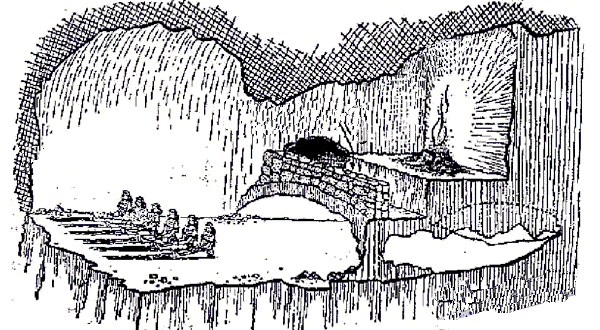
The fallout from releasing once secret information can be
seen on a daily basis. It seems like this year has had more scandal than others
I can remember. Or maybe I’m just paying attention more. When controversial
secret information comes out, the backlash is complete media immersion. If the
topic is somehow sports related, all sports outlets drop everything and talk
about it. The same goes for entertainment and those outlets. I often wonder if
these situations hinder the process of selecting an unbiased jury. So this must
be considered when an individual intends to expose something. Passing on a
rumor could completely ruin someone’s life.
Photo Credits:
http://img.tgdaily.com/sites/default/files/stock/450teaser/gavel.jpg
http://webspace.ship.edu/cgboer/PlatosCave.gif)
Thursday, January 5, 2012
Gossip Ethics
Potential Scenario
In a potential career as an entertainment journalist/film critic there is one fundamental type of news that I believe to be a large ethical dilemma. The concept of right to privacy has all but disappeared as entertainment news is now gossip. I am a fan of news regarding upcoming film releases, actors signing on to projects, and award show buzz. The problem comes with the lower end “news.” TMZ has been in the forefront of this deep-seeded love for rumors that don’t need to be based in actual reality. Are celebrities real people? I would hope so. Therefore people shouldn’t dig up any irrelevant detail about their private life and plaster it all over the internet.
 However, this kind of information sells. Drama regarding Kim Kardashian or Charlie Sheen makes its way into actual newspapers and magazines because people are intrigued and interested. But Kardashian’s circus wedding put her relationship in the spotlight to begin with, so she isn’t without blame. It’s obvious I have a personal opinion, but that may change if I were in a situation where printing this could help a company I worked for.
In regard to our course and potential topics to be discussed, I would like to address this rumor dilemma. Why is this the best-selling news and how should educated individuals approach it? I used to just write off everything I saw on the “gossip rags.” But somehow these unsubstantiated claims often turn it to be correct. Is getting the scoop more important than strong sources and double checking for truthfulness?
Ethical Tools
I initially thought that I had a strong ethical foundation, but it appears that it is more of a moral foundation. This is a great tool to have and it has helped me a lot in my life so far. I will have to wait and see if the lines get a little more blurred through further ethical discussion and a potential job where I have an obligation to more than my family and myself. From this week’s readings I found Aristotle’s “Golden Mean” theory to be the most interesting. I’ve essentially been living unknowingly by this model for a long time, but to see it written out adds a more detailed perspective. The other theories are helpful, but Aristotle has the only one listed where I can base my decisions on what is considered to be acceptable.
In the chart provided on page 9 of “Media Ethics,” it shows bravery sitting between cowardice and foolhardiness as the acceptable behavior of the three. However, the subjective interpretation of these terms would cause some people to engage in the other two. The example I think of is with the X-Games. The majority of people would consider doing no-handed backflips on a motorcycle as foolhardy. I would agree with that. However, this entire brand has been built by people interpreting these actions as brave. It really forces one to think deeply about whether or not their actions and thoughts are based in reality. This may not be an ethical choice, but it can certainly be applied to interactions of that sort.

Friday, December 2, 2011
Full Disclosure
Regal Entertainment Group's strategies for reaching investors lie mainly with their website. Questions can be asked with an online form that will be returned with a specific answer or the location to which that information could be found on the site. Then there are the traditional press releases and quarterly conference calls that are common with publicly traded companies. In order to stay connected with the community, Regal has the Regal Foundation. They work with well-established philanthropic groups in the community’s where their theaters are. Like I’ve said in previous posts, this group apparently does a lot working with the important groups like Boys and Girls Clubs, but this involvement is hardly seen on a daily basis. Though they do have a fairly impressive write-up on their website for all the good they do through this effort. They of course have Twitter to communicate with fans, as well, though they could probably do more in terms of customer service.
One of the government bodies they work most closely with is the Motion Picture Association of America (MPAA,) which rates films and enforces theaters use of those age guidelines. Also Regal communicates with the National Association of Theatre Owners (NATO) and the Inter-Society Digital Cinema Forum to make sure their theaters present a number of open captioned and descriptive video options for hearing and visually impaired viewers. Then there is the Department of Health who deal with the concessions stands in individual cities. The communications with these groups are mandatory so they regulate the interactions. The corporate office is likely the place which meets with such groups.
I think Regal needs to expand their outreach to all individuals. They are a specified company, but in the face of a crisis, being a well-known brand would potentially help gain favor with the public. Keeping up frequent communications with government agencies would be a good first step so that minor infractions wouldn’t occur that might hurt the brand. With the evolving look Regal always utilizes with their new theaters, the best solution for dealing with a crisis would be to take advantage of that constant change. Another approach could be to upgrade the other brands under the Regal label. United Artist Theaters and Edwards Theatres are both owned by Regal. So if a crisis came out for any of the brands, another could increase its exposure to fill the void.
The most important strategy for any crisis is full exposure and immediately addressing issues. If we’ve learned anything with the tons of scandals in the news lately it’s that sitting on a crisis will only make it worse. Fixing the problem followed by immediate efforts to improve the image is essential. Since Regal has their foundation in place, I imagine they would emphasize its existence much more if a question were raised about the company’s character. It almost seems that firing the executives is the general perception of how to handle a crisis. But a lot of time the public and media are just looking for full disclosure and transparency.
Friday, November 25, 2011
Internal Regal
As far as I can tell by researching Regal from an outsider’s perspective, they have little in the way of internal publications. Of course since I don’t work for the company I may be incorrect. As is common procedure, they release stock reports for stockholders. Those contain some information regarding the company’s gains, plans, etc. As I have said in previous posts, I don’t think a blog would necessarily be appropriate for a company like Regal. While they spend plenty of time and effort on their theaters, the general public isn’t overly concerned with the goings on of a movie theater chain, though an internal blog could be a different story.
Since I’ve witnessed many people asking theater employees about a current or upcoming film, it may be beneficial to give some information about them in an organized manner. Allowing free screenings would probably be too much, but some official information, links to videos with the actors and director, could help. This would give credibility to what the guy selling popcorn at the concession stand thinks about “The Muppets.” As of now it’s completely riddled with bias and half-truths they gained on their own. If they had some official information released to them they could point to an anecdote by the director or give a more optimistic and truthful response.
In reality this type of blog or newsletter could be open to the public as well. It could build anticipation for a certain film, which would bring people to the theaters. However, it may not be worth paying for the rights to the brands and titles when studios are already spending a fortune on advertising. It would be more appropriate for funds to go directly into the theaters. The current external newsletter used by Regal, “the show time newsletter,” provides the times movies are playing that week and an occasional promotion. It doesn’t offer much more information.
While Regal uses popular characters from current films on their website to promote those movies, they do not have a celebrity spokesperson. I have seen other theater chains use an on-screen personality for the segments they air before the movies begin. Bow-Tie Theaters, for example, use a man who talks about upcoming movies and name drops the theater group every few seconds. Regal has a narrator for this. It wouldn’t hurt to have a known celebrity for this task. But again, that’s spending money that may not be necessary. Celebrities alienate certain people depending on their personalities. Regal seems to always go with the option of letting their product (movie theaters) speak for themselves.
If I were to pick someone appropriate to be a celebrity spokesman, they would have to be credible in the film industry. There was once a limited time video shown at Regal where Martin Scorsese enters a real life moment and begins directing the people. The point was they don’t interrupt your life, so don’t interrupt their movies. I noticed it was met with positive responses from most. Someone like Scorsese would fit well in a role for the theater chain. But he would probably only do it for a small fortune.
Friday, November 18, 2011
Corporate vs. Commercial
Regal Entertainment Group uses a two-fold media relations strategy. As to which aspect is approached as the top priority, I can’t be sure. The corporate side of the company is based around keeping a clean image in the minds of stockholders. As a publicly traded company, there must always be a concern with how they appear in terms of growth potential and stability. So on the Regal website there are many official statements and investor reports, which provide the appropriate information. This content keeps with standards of a more traditional media strategy.
Then there is the opposite side of the coin for the average Joe moviegoer. Easier to find and more direct, the content related to upcoming movies and discounts and promotions is very prevalent throughout the site. An interesting thought may be that Regal thinks investors have more time or patience to go digging through the site to find their content, while the common folk need flashy promos on the homepage to navigate around. I may be way off with that guess but the way the content is displayed is quite different.
In addition to the short bursts of information on the site, there is the possibly even more instant media of Facebook and Twitter. As I said in my previous post, their Twitter has more of a customer service presence than their Facebook does. I find that variation in content present on Twitter as more appealing to the varying demographics who potentially view it. But since Facebook has more of an adult presence on it, Regal should consider direct communications with fans through that outlet.
Regal Entertainment’s branding proves to be vital in both methods of the company’s media relations. While there are a number of theaters that are small, Regal boasts of a vast number of large cinemas. This example appeals to the average person who would rather experience a movie on a large screen with more seats, as well as the stockholder who sees sustainability and growth in the company.
The methods employed by Regal are a successful conglomerate of new and old media relations techniques. They are not afraid to use Twitter, which states non-controversial opinions of movie news topics as a representation of their company. It may not appeal to a TV news anchor in this format, but the fact that Regal’s crown symbol appears in thousands of people’s Twitter feeds every few hours means that they are reminded of the company. Then when it’s time to go to the movies the brand is right there in your mind. This is especially true for the 18-35 demographic, which is more likely to go to the movies and bring friends along.
I think the media strategy could be improved through a more thorough use of Facebook. Also it may be more efficient to provide a space intended only for stockholders. Currently they have to navigate through free popcorn coupons and “Happy Feet” movie promotions. If someone is interested strictly in the business side of Regal this may be inconvenient.
Friday, November 11, 2011
Spreading the Word
Running a chain of movie theaters is likely as stressful as running any other type of business. One thing they do have going for them however is promoting their brand using characters from popular movies. This case of social bookmarking likely brings in searches in regard to those separate brands. For instance, Regal's homepage features a number of characters currently in theaters and without needing to gain permission from the movie studio. A car company, for example, wouldn't have the same luxury.
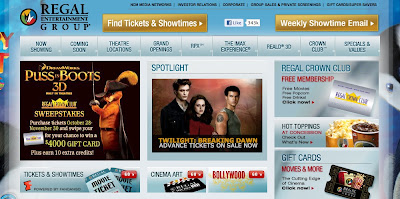 The content inventory for Regal Cinemas is split between informative content and promotional material. Taking content inventory reveals a strong focus on showing what their brand has to offer including their Crown Club, RPX and IMAX theaters. From there the emphasis turns to promotion in regard to their theaters, as well as the movies that will be featured there. With how popular it is expected to be, I cannot imagine that it hurts to put an image of the stars of “Twilight: Breaking Dawn” next to your company name. Regal spares no expense in filling a number of site pages with coupons and discounts for concessions and an occasional movie ticket.
The theater group has joined the social networking party by expanding to Facebook, Twitter and Youtube. Their Facebook page is mostly promotional content with coupons, news of their events and contests. They post approximately twice daily and usually link to new movie trailers or breaking news in the film industry. Their Twitter page is more user friendly. It is clear they use this outlet to not only mention the promotions and such, but also interact with fans and customers. For example, one of the most recent tweets has Regal responding to a customer who couldn’t get a question answered by calling her local Regal theater. With about five tweets daily, Twitter seems to be their go to social media tool for customer interaction. Regal also operates a Youtube page, though that is almost completely movie trailers.
Facebook and Twitter encompass many elements of social networking including micro-blogging. Those few sentence status updates or wall posts provide the information that could be otherwise expressed through a third party blog. In regard to full blog posts, like the one you’re reading, Regal Cinemas steers away from that outlet. Also, since the movies do a lot of the work to get people into the theaters, incentives are more important than listing a lot of written content.
Regal Entertainment Group is a large corporation dealing with entertainment. The fact that they have embraced social networking and use mostly short concise items on their website says that they are looking to draw in potential customers who are just passing through and keep those who have already discovered their brand. While people of all ages go to the movies, there are quite a few movies targeted for the teen demographic. With this in mind, Facebook and Twitter are a must. Overall Regal does well with managing their content to best represent their product, successful movie theaters.
 The content inventory for Regal Cinemas is split between informative content and promotional material. Taking content inventory reveals a strong focus on showing what their brand has to offer including their Crown Club, RPX and IMAX theaters. From there the emphasis turns to promotion in regard to their theaters, as well as the movies that will be featured there. With how popular it is expected to be, I cannot imagine that it hurts to put an image of the stars of “Twilight: Breaking Dawn” next to your company name. Regal spares no expense in filling a number of site pages with coupons and discounts for concessions and an occasional movie ticket.
The theater group has joined the social networking party by expanding to Facebook, Twitter and Youtube. Their Facebook page is mostly promotional content with coupons, news of their events and contests. They post approximately twice daily and usually link to new movie trailers or breaking news in the film industry. Their Twitter page is more user friendly. It is clear they use this outlet to not only mention the promotions and such, but also interact with fans and customers. For example, one of the most recent tweets has Regal responding to a customer who couldn’t get a question answered by calling her local Regal theater. With about five tweets daily, Twitter seems to be their go to social media tool for customer interaction. Regal also operates a Youtube page, though that is almost completely movie trailers.
Facebook and Twitter encompass many elements of social networking including micro-blogging. Those few sentence status updates or wall posts provide the information that could be otherwise expressed through a third party blog. In regard to full blog posts, like the one you’re reading, Regal Cinemas steers away from that outlet. Also, since the movies do a lot of the work to get people into the theaters, incentives are more important than listing a lot of written content.
Regal Entertainment Group is a large corporation dealing with entertainment. The fact that they have embraced social networking and use mostly short concise items on their website says that they are looking to draw in potential customers who are just passing through and keep those who have already discovered their brand. While people of all ages go to the movies, there are quite a few movies targeted for the teen demographic. With this in mind, Facebook and Twitter are a must. Overall Regal does well with managing their content to best represent their product, successful movie theaters.
Friday, November 4, 2011
The Crown
Regal’s overall branding model is consistent with their name in size and scope. However, the jury is still out on whether the locationas are actually fit for kings. Their theaters often appear in the form of large multiplexes averaging over 12 screens. There is an apparent interest in keeping with traditional movie theater elements, though they have been distinctly upgraded. Large marquees in lobbies are now almost exclusively digital. I’m sure some miss the traditional marquee, but that’s the way cinemas are headed.

As far as I’m concerned movie theaters do not have any other responsibilities beyond providing a clean, safe and welcoming environment to watch movies. That’s why I am surprised to learn that Regal Cinemas has a foundation, which gives back to the communities that house their theaters through donations to groups like the Boys & Girls Clubs of America. I have never seen the impact of this organization. That would be a great point to emphasize in order to brand the company as socially aware. Maybe the executives are actually trying to make a difference without receiving something in return.
Like many other businesses, Regal Entertainment Group has a logo for any situation. Following that is a laundry list of regulations on the usage of those symbols. If I’m not in class on Tuesday please come bail me out of jail for using the Regal Cinemas symbol in my post. Can you guess what that thing in the circle is? I thought it was a strange popcorn kernel for years, but staring at it for 20 minutes has told me that it is a crown. How regal.

Now that I’ve had this revelation, the group’s Crown Club Card makes a lot more sense. The points based system gives incentives to frequent moviegoers. It’s nothing that hasn’t been seen before, free sodas, discount candy and the holy grail of theater rewards, the free movie ticket (some restrictions apply, of course). This is a powerful strategy to keep fans happy. Ticket prices are expensive at most theaters so anything that is “free” surely is appreciated. They obviously know that those who get the free popcorn will buy a drink to accompany it. But I never do. That’s my way of sticking it to the man. I wonder if they feel that burn in their potentially deep pockets.
Since Regal Entertainment group must balance their branding between the common people who go to the movies and fickle stockholders they don’t seem to have much gimmicky advertising. Plus, in the mid-sized markets that the theaters are located in, there is the potential that lack of competition will usually bring in customers. From an outsider’s perspective the company is successful at branding themselves as a modern movie theater chain that is up to date with the latest technologies.
Wednesday, October 26, 2011
The Regality of it All
When America thinks of rapidly expanding, successful corporations they obviously turn to the movie theater business. No? What were you thinking, energy or Wal-Mart or something? As a movie connoisseur myself, I've been in many different theaters. There are the indie movie houses all the way through the stadium IMAX with a barf bag at the ready because it’s just so massive. Take your pick as to which you'd prefer. Personally I like the immersive spectacle of Regal Cinemas.
 Their theaters aren't necessarily the biggest, but I've witnessed the way the company can take over a theater that is dipping in quality and update it to a point where the locals didn’t know what they were missing. However, their pockets will. Ticket prices are steep, but still comparable to other multiplexes of the specific region. Plan on seeing a movie in NYC? Hope you’re okay without eating dinner this week.
According to the Regal company overview, they operate 12.4 screens per location. While I’m sure there must be some kind of selection process in picking which films to show on those screens, the company is left with the task of providing a quality environment, and then inevitably people will come to see Hollywood’s finest earning their paychecks.
That environment consists of the almost expected inclusion of stadium seating, digital picture and sound, with a cornucopia of unnecessary foods at the snack bar. After sitting through the ad before the previews a few dozen times, you would know what they offer too. However, the ads aren’t as blatant as at other cinemas. Regal has an ad that takes the audience on a roller coaster ride through the concessions. It’s quite fun.
The supposed targets for their theaters are “mid-sized metropolitan markets and suburban growth areas of larger metropolitan markets throughout the U.S.” But does a Times Square location fit into those categories? The difference being that the Times Square locale features RPX, which is the company’s answer to IMAX, with speakers in high backed seats and giant screens. So I guess the largest markets are where they use that “ace up their sleeve.” In regard to specific demographics targeted, the movies themselves handle those divides.
Their mission (should you choose to accept it) is that “Regal Entertainment Group operates the largest and most geographically diverse theatre circuit in the United States…” Could be true, but it would be a large-scale project to try and prove it. The company can make a claim like this because it will appeal to stockholders and their common customers don’t care. They are more interested in the stadium-recliner seating. The company was founded I 1989 and became publicly traded in 2002, so they’ve been around a bit and I dare say as a moviegoer, I think they know how to operate a theater successfully. I don’t know how it is behind the scenes, but since I’m not a stockholder, it doesn’t really matter.
Subscribe to:
Posts (Atom)